
What is an Audit Trail? : Meaning, Types, and Applications
What is an Audit Trail?
An audit trail is a chronological, tamper-evident record of every action, transaction, or event that occurs within a system, process, or document. It captures who did what, when they did it, and what changed – creating an unbroken chain of evidence that supports accountability, compliance verification, and fraud detection across financial and operational systems.
How an Audit Trail Actually Works
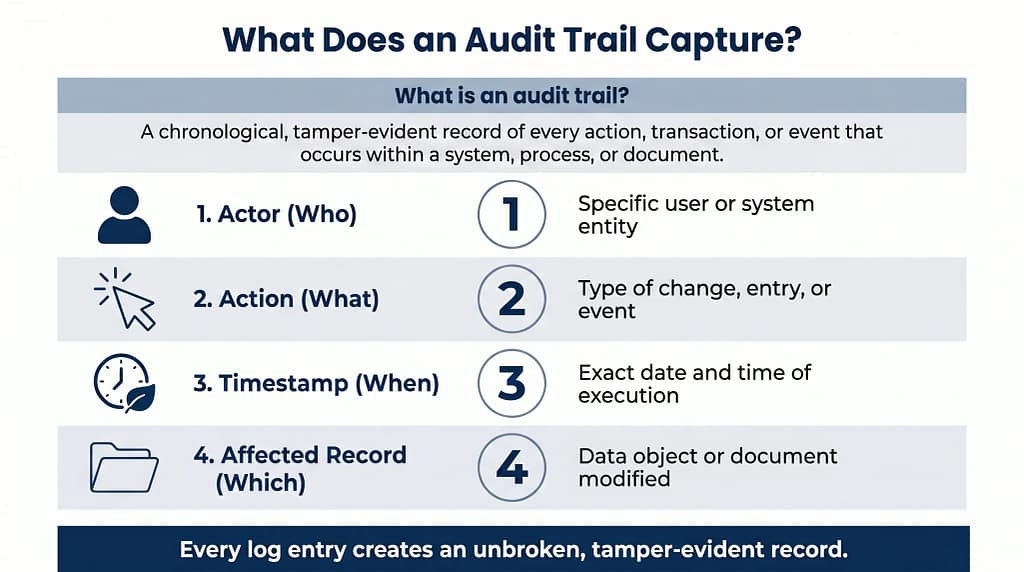
An audit trail refers to the systematic logging of activity across a system or process in real time. Every entry captures four core data points: the actor (who), the action (what), the timestamp (when), and the affected record (which). Together, these entries form a sequential log that cannot be altered retroactively without detection.
Think of it like the black box recorder on a commercial aircraft. The plane doesn’t wait for something to go wrong before it starts logging. It records everything continuously – altitude, speed, system status – so that if something does go wrong, investigators have a complete, unambiguous account of events. The principle works the same way: logging runs in the background, silently capturing activity, and only becomes critically important when someone needs to reconstruct what happened.
In practice, these records operate at multiple levels. The financial variant logs every transaction, journal entry, and approval in an accounting system. The IT version tracks login attempts, data access, and configuration changes. The document layer records every edit, comment, and version in a file management system. Each type serves the same fundamental purpose – traceability – but the data captured varies significantly by context.
What information does an audit trail capture?
An audit trail captures the identity of the user who performed an action, the exact timestamp of that action, the type of change made, and the specific record or data object affected. More advanced systems also log the IP address, device, and session ID associated with each event, giving compliance and security teams a fuller picture of system activity.
Audit Trail in Accounting
Audit trail in accounting is defined as the documented sequence of records that traces every financial transaction from its origin to its final entry in the general ledger. Accountants and auditors use it to verify that financial statements accurately reflect underlying transactions and that no entries have been altered, deleted, or fabricated.
This matters more than most people realise. According to the Association of Certified Fraud Examiners (ACFE) 2024 Report to the Nations, organisations lose an estimated 5% of annual revenue to fraud each year – and a significant portion of those losses persist precisely because inadequate record-keeping obscures the trail of wrongdoing. A well-maintained record like this is one of the most effective preventive controls a finance team can deploy.
Modern accounting platforms and AP automation tools like Vapusdata build this functionality directly into the system. Every posted journal entry, modified invoice, or deleted transaction generates an automatic log entry. Finance teams can pull an audit trail report at any point — during month-end close, ahead of an external audit, or in response to a suspected discrepancy — and trace any number back to its source within minutes.
Building on this, it also plays a direct role in regulatory compliance. SOX-compliant organisations in the United States, for instance, are required to maintain complete, accurate, and retrievable records of all financial activity. An unbroken record is not optional – it is a legal obligation.
What is an audit trail report?
An audit trail report is a structured document or system-generated log that presents a chronological record of all tracked actions within a defined scope – such as a specific account, time period, or user. Finance and compliance teams use audit trail reports to verify transaction accuracy, investigate anomalies, and demonstrate regulatory compliance during internal or external audits.
Audit Trail Requirements Across Regulatory Frameworks
Audit trail requirements vary by industry and jurisdiction, but the underlying expectation is consistent: records must be complete, accurate, time-stamped, and protected against unauthorised modification.
Under HIPAA in healthcare, organisations must track every instance of access to protected health information (PHI) — including who accessed it, when, and from where. In financial services, regulations like SOX, PCI DSS, and GDPR each impose specific requirements around how long logs must be retained (typically between one and seven years) and how quickly they must be retrievable. In pharmaceutical manufacturing, FDA 21 CFR Part 11 mandates electronic records for any system that creates, modifies, or deletes data related to regulated products.
Here’s the thing – many organisations invest heavily in logging technology but underinvest in governance. Capturing logs is only half the equation. Those logs need to be reviewed regularly, stored securely, and accessible in a format that satisfies auditors. A log that exists but can’t be retrieved in time for a regulatory request provides very little actual protection.
How long should audit trail records be retained?
Audit trail requirements around retention depend on the applicable regulatory framework. Under SOX, financial records must be retained for a minimum of seven years. HIPAA requires logs related to PHI to be kept for at least six years. PCI DSS mandates a minimum of one year for log retention, with at least three months immediately available for analysis.
Advantages of Maintaining a Strong Audit Trail
A well-maintained logging system delivers returns across compliance, operations, and risk management — often simultaneously. Here are the core advantages:
Fraud Deterrence When every action is logged and traceable, the opportunity space for undetected misconduct shrinks. According to the ACFE’s 2024 report, organisations with proactive data monitoring controls experienced fraud losses 54% smaller than those without.
Faster Audit Cycles Clean, automated logs eliminate the need to manually reconstruct transaction histories before an external audit. Finance teams pull a structured report directly from the system – saving time, reducing professional fees, and cutting disruption.
Regulatory Compliance Confidence When a regulator requests evidence under GDPR, HIPAA, SOX, or PCI DSS, complete records let your team respond quickly and precisely. Scrambling to reconstruct data after the fact costs far more than maintaining proper logs from the start.
Operational Accountability Every approval, exception, and override gets recorded. Managers gain real visibility into how processes are actually being followed – not just how they were designed to work – closing the gap between policy and practice.
Faster Incident Response When a breach, duplicate payment, or unauthorised change occurs, these records are the first resource investigators use. Organisations with complete logs resolve incidents in hours. Those without them face investigations that stretch into weeks and still produce inconclusive results.
What is the biggest advantage of an audit trail?
The biggest advantage of an audit trail is the combination of fraud deterrence and incident traceability it provides simultaneously. It both reduces the likelihood of misconduct and dramatically accelerates investigation when something goes wrong – making it one of the highest-return controls any organisation can maintain.
Types of Audit Trail
The types an organisation maintains depend on the systems it operates and the regulations it answers to. The most common ones are:
Financial Audit Trail Tracks every transaction, journal entry, payment approval, and ledger modification within an accounting system. The most universally required type — needed by virtually every regulated business.
System or IT Audit Trail Logs user access events, login attempts, configuration changes, and data transfers within software infrastructure. Essential for SOC 2, ISO 27001, and cybersecurity incident investigations.
Document Audit Trail Records every version, edit, comment, and access event tied to a specific file. Standard in legal, compliance, and contract management workflows on platforms like SharePoint and Google Workspace.
Operational Audit Trail Captures workflow activity – approvals, escalations, status changes, and handoffs across business processes. In accounts payable, this means every touchpoint an invoice passes through from receipt to payment. Vapusdata, for instance, generates a built-in operational log for every action taken within its AP automation platform – so finance teams always have a complete, retrievable record without any manual effort.
Database Audit Trail Logs every query, insert, update, and delete operation at the infrastructure level. Critical in healthcare and financial services where the underlying data records are themselves regulated.

What is the most common type of audit trail?
The most common type of audit trail is the financial audit trail, which records every transaction and modification within an accounting or ERP system. It is most frequently required by regulatory frameworks including SOX, GAAP, and IFRS, and the one most commonly reviewed during external audits.
Audit Trail Applications Across Industries
Audit trail applications extend well beyond accounting and IT security. Any system where accountability, traceability, or compliance matters benefits from structured logging.
In healthcare, activity logs track every access to patient records, every medication order, and every change to a clinical note – protecting both patient privacy and clinical integrity. Legal services, document management platforms maintain detailed version histories and access logs for every file, protecting attorney-client privilege and chain of custody. In supply chain management, tracking systems record every movement of goods, every handoff between parties, and every quality inspection – creating the traceability that regulators and enterprise buyers increasingly require.
Arguably the most underappreciated application is its role in internal investigations. When an employee dispute, a vendor fraud allegation, or a data breach occurs, the activity log is often the first place investigators look. Organisations that maintain clean, complete records – whether through a dedicated platform like Vapusdata or a broader ERP system – can resolve these situations quickly and with confidence. Those without them face lengthy, expensive, and often inconclusive investigations.
Future of Audit Trails Is Automated and Continuous
Managing these records manually is already becoming obsolete. As organisations migrate to cloud-based ERP systems, SaaS platforms, and AI-driven workflows, the volume of loggable events grows exponentially. According to Gartner, by 2026, more than 75% of organisations will adopt some form of continuous controls monitoring – a framework that depends entirely on real-time, automated log data.
The direction is clear: these records are moving from a compliance checkbox to a live operational intelligence layer. Finance and IT leaders who treat this infrastructure as a strategic asset – rather than a back-office requirement – will be far better positioned to detect issues early, satisfy regulators without scrambling, and build the kind of institutional trust that increasingly defines competitive advantage.
FAQs
An audit trail is a chronological, tamper-evident record that logs every action, transaction, or change within a system or process, capturing who performed the action, what changed, and when it occurred. It serves as the primary mechanism for accountability, compliance verification, and forensic investigation across financial, IT, and operational systems.
2. What is audit trail meaning in accounting?
Audit trail meaning in accounting refers to the documented sequence of records that traces every financial transaction from its point of origin through to its final entry in the general ledger. It allows auditors and finance teams to verify the accuracy of financial statements and detect any unauthorised or erroneous changes to financial data.
3. What are audit trail requirements?
Audit trail requirements are the regulatory and legal standards that govern how organisations must capture, store, and retain activity logs. Requirements vary by framework — SOX mandates seven years of financial record retention, HIPAA requires six years for PHI-related logs, and PCI DSS requires a minimum of one year — but all frameworks share a common standard of completeness, accuracy, and retrievability.
4. What is an audit trail report?
An audit trail report is a system-generated or manually compiled document that presents a chronological log of all tracked activity within a defined scope. Compliance officers, external auditors, and finance teams use audit trail reports to verify transaction integrity, investigate discrepancies, and demonstrate regulatory compliance.
5. What are the main audit trail applications?
A: Audit trail applications span healthcare, financial services, legal, supply chain, and IT security. In each domain, the primary function remains the same — providing a traceable, tamper-evident record of activity that supports accountability, regulatory compliance, and incident investigation. cases