Agentic AI Explained: What I’ve Learned Building It
A few months ago, I was on a call with a platform architect at a mid-sized fintech. They had just finished a six-month project stitching together a pipeline to automate their loan underwriting triage – pulling credit data, running models, flagging anomalies, routing to human reviewers. Classic ML-ops work. Good team. Solid build.
Then he said something which struck: “We basically built a really expensive if-else chain with a neural network in the middle.”
He wasn’t wrong. And honestly, I’ve said almost the same thing about systems I built at previous companies.
You write rules. You train models. You connect them with orchestration tools – Airflow, Prefect, whatever you’re using – and you get something that looks smart until the scenario changes slightly, and then it doesn’t.
That conversation is more or less why I want to write this post about what Agentic AI brings to the table.
What Is Agentic AI?
Here’s how I think about it, plainly: agentic AI refers to AI systems that can pursue goals over multiple steps, make decisions along the way, use tools, and adapt when things don’t go as planned – without a human scripting each move.
That’s different from a model that answers a question. It’s different from a pipeline that runs on a schedule. An agentic system reasons, acts, observes the result of that action, and reasons again. The loop is the point.
The word “agentic” comes from agency – the capacity to act independently toward a goal. When people say AI agent, they typically mean an LLM (or ensemble of models) that’s been given a goal, a set of tools, and enough context to figure out a path. When I say agentic AI, I mean systems designed around that capability – architecturally, not just as a one-off prompt trick.
A term I’d push back on: “autonomous AI.” Every system I’ve seen called autonomous still has hard guardrails, approval loops, and human-in-the-loop checkpoints in production. That’s fine – it should. But calling these systems fully autonomous sets the wrong expectations, and I’ve watched teams burn trust with stakeholders because they oversold the autonomy angle.
A more useful framing: agentic AI systems are goal-directed and adaptive. They’re not just reactive.
Key terms worth knowing:
- LLM agents – language models that can reason and take action using tools
- AI agent orchestration – the system managing how agents are created, tasked, and coordinated
- multi-agent systems (MAS) – architectures where multiple agents collaborate or compete to accomplish a task
- tool use – the ability for an agent to call APIs, query databases, run code, or read files mid-task
The State of Traditional AI Today
I spent a long time building data platforms before starting Vapusdata. And what I saw, consistently, was this: companies would invest heavily in ML infrastructure, train genuinely good models, and then watch those models sit in a corner of the stack, rarely integrated into anything that moved.
The disconnect was orchestration. You had a fraud model over here, a churn model over there, a recommendations engine somewhere else – and connecting them to actual business workflows meant building custom glue code every single time. Apache Airflow would manage the scheduling. dbt would handle the transformations. A data quality tool like Great Expectations or Monte Carlo would catch drift. But none of these pieces talked to each other intelligently. They executed steps. They didn’t think.
What I told customers was: your AI is as smart as the people who wired it together. If the wiring is brittle, the system is brittle.
The other problem was adaptation. Traditional ML pipelines break when inputs shift – and they break silently, or they break noisily and expensively, but either way they require a human to diagnose and fix them. That’s not a knock on the engineers. That’s just the architecture. It wasn’t built to reason about its own failures.
How Is Agentic AI Different from Traditional AI?
The simplest contrast I can give: traditional AI systems execute. Agentic AI systems decide.
I used to write DAGs in Airflow that looked like decision trees. Task A runs, passes output to Task B, which branches to Task C or D based on a condition I’d hardcoded. Smart enough for stable environments. Terrible when something unexpected happened upstream.
Now, with an agentic system, I can hand a goal to an LLM-powered agent – say, “investigate why data quality scores dropped in this pipeline” – and it’ll query the metadata catalog, check recent schema changes, run a few statistical tests, and come back with a hypothesis. I didn’t script those steps. The agent reasoned through them.
That’s the shift. From “execute this sequence” to “figure out how to accomplish this.”
Where Agentic AI Enters the Picture
Automating Complex, Multi-Step Workflows
The use case that convinced me this wasn’t hype was watching an agentic system handle a customer data reconciliation task that normally took two engineers a day. The agent pulled records from three systems, identified mismatches, traced them to source, flagged likely causes, and drafted a resolution summary. Not perfectly. But well enough that the two engineers spent twenty minutes reviewing instead of eight hours doing.
That’s the pattern I keep seeing: agentic AI doesn’t replace the engineer. It compresses the cycle.
AI Agent Orchestration in Data Platforms
In data infrastructure specifically, orchestration has always been the hard part. You can have great models and terrible outcomes if the coordination layer is weak. Agentic AI changes this by giving the orchestration layer some intelligence. Instead of routing by rule, you can route by reasoning.
We’ve built the Vapusdata’s platform around this idea – letting agents manage data product workflows dynamically rather than following a fixed pipeline. The reliability gains come from the fact that the agent can recognize when something’s off and reroute, rather than failing silently.
Autonomous AI Agents in Operations and Monitoring
The other place I see this working well: ops. Not glamorous. But an agent that can monitor system health, correlate alerts, and take a first-pass diagnostic action before paging a human is genuinely valuable. The question is how much reasoning you want in the loop versus how much rule-based logic.
The Problems This Actually Solves
Benefits of Agentic AI
Honestly, the benefit I care most about is reducing the cost of complexity. Every time you add a new data source, a new model, or a new workflow to a traditional pipeline, you add integration work. Agentic systems can absorb some of that complexity dynamically – they can figure out how to call a new API, read new documentation, adapt to a new schema – without a full rebuild.
The second benefit is adaptability. McKinsey’s research on AI adoption has consistently pointed to brittle integration as a top reason AI projects fail in production. Agentic systems are better positioned to handle edge cases because they can reason about them rather than fail on them.
Agentic AI vs. AI Agents
People conflate these two. An AI agent is a single instance – an LLM with tools, a goal, and a reasoning loop. Agentic AI is the broader design philosophy and architectural pattern that these agents inhabit. You can have one agent doing something useful. Agentic AI is what you call the system when the design principle is agency throughout.
What Are Multi-Agent Systems (MAS)?
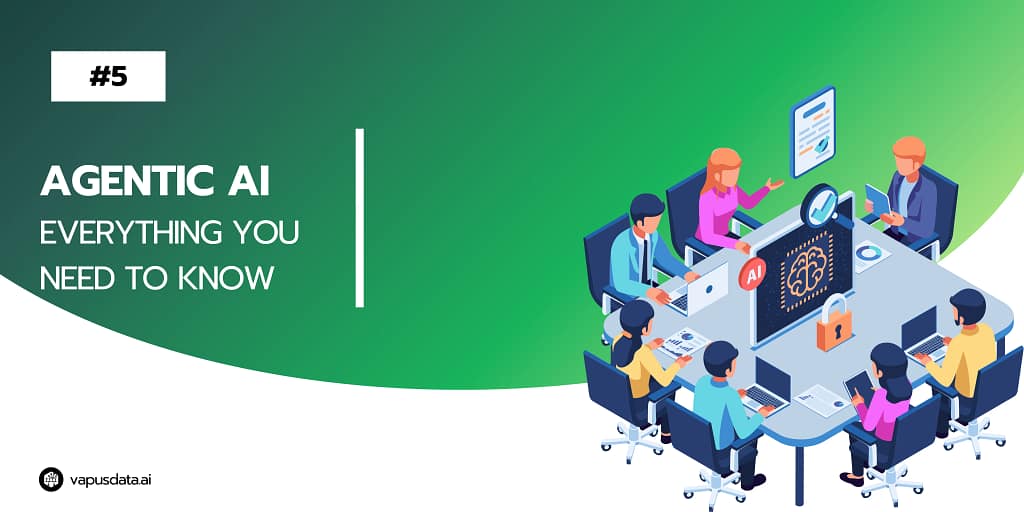
A multi-agent system is what you build when a single agent isn’t enough. Think of it like a team: one agent researches, one agent writes, one agent reviews. Or in a data context: one agent monitors pipeline health, one investigates anomalies, one coordinates remediation.
The analogy that works for me – and I’ll only use one here – is a newsroom. The editor doesn’t write every story. They direct reporters, review drafts, escalate when something’s big, and synthesize across multiple sources. A well-designed MAS operates similarly: roles, handoffs, and a shared objective.
What makes MAS hard isn’t building the agents. It’s the coordination logic. How do agents share context? How do you prevent them from working at cross-purposes? That’s where most teams underestimate the engineering.
Real-World Applications of Agentic AI Across Industries
Finance
In financial services, agentic AI use cases cluster around three things: compliance monitoring, audit trails, invoice processing, reconciliation and research synthesis. A compliance agent that can read a new regulatory document, cross-reference it against current workflows, and flag gaps is genuinely useful – and much faster than waiting for a compliance team to do a manual review.
Healthcare
Clinical documentation is an obvious target. An agent that can pull patient history, cross-reference relevant literature, and draft a clinical note for physician review isn’t replacing the physician — it’s giving them back the twenty minutes they would have spent on data retrieval. According to research from MIT’s Computer Science and Artificial Intelligence Laboratory, AI-assisted workflows in clinical settings can cut documentation time significantly without reducing accuracy.
Retail
Demand forecasting, inventory optimization, and personalized merchandising are all areas where agentic approaches are starting to outperform traditional ML pipelines, because they can adapt to real-time signals – a trending product, a supply chain disruption, a weather event – and adjust recommendations without waiting for a model retrain cycle.
Challenges of Agentic AI
Keeping It Governed
Here’s the thing – and I want to be direct about this – the biggest risk with agentic AI isn’t that it’ll go rogue in a science fiction sense. The risk is subtler: agents making confident, wrong decisions at scale, faster than anyone can catch them.
When a human makes a bad call in a workflow, you catch it at the next handoff. When an agent makes a bad call and the next step also has no human in the loop, you can be three bad decisions deep before anything surfaces. I’ve seen this happen with simpler automation, and it’s worse with agents because the reasoning looks coherent even when it’s wrong.
What I tell teams: governance isn’t a product feature you add later. Design your approval loops before you design your agents.
Gartner’s analysis on AI trust and risk highlights this exact failure mode – agentic systems require audit trails, explainability hooks, and rollback mechanisms from the start, not retrofitted after the first incident.
What I’ve Learned the Hard Way
I’ll be honest about something: I expected tool use to be the hard part. It wasn’t. LLMs have gotten surprisingly good at figuring out which tool to call and when.
What I didn’t expect was how much the quality of context matters. We built an early version of an agentic workflow at Vapusdata where the agent had access to all the right tools but kept making suboptimal decisions. We spent two weeks tweaking the reasoning prompts before we realized the real problem: the metadata the agent was reading was incomplete. The agent was reasoning correctly from bad inputs.
Garbage in, garbage out is not a new lesson. But it hits differently when your “in” is what an LLM decides to reason over, and your “out” is a decision that triggers a real action in a production system.
The humbling thing about agentic AI is that it exposes every weak point in your data foundation. In some ways, that’s useful – it forces you to fix things you’ve been ignoring. But don’t let anyone sell you an agentic AI solution as a shortcut around data quality work. There is no such shortcut.
Where This Is All Heading
I could be wrong about this, but I think the next big shift isn’t going to be smarter individual agents. It’s going to be better coordination infrastructure – the systems that manage how agents are spawned, how they share memory, how they hand off context, and how failures get handled cleanly.
Right now, most multi-agent systems are held together with careful prompt engineering and hope. That’s not a sustainable architecture for enterprise. The companies that figure out robust agent orchestration – not just at the model layer but at the infrastructure layer — are going to have a serious advantage.
I also think we’re going to see a collision between agentic AI and data mesh principles. As organizations decentralize data ownership, they’ll need agents that can operate across domain boundaries without centralized coordination. That’s an unsolved problem, and it’s one I think about a lot.
The hype cycle will do what hype cycles do. But underneath it, something real is happening. The question isn’t whether agentic AI will matter. It’s whether your organization builds the foundation to make it work or spends two years cleaning up after a rushed deployment.
How to Get Started – What I’d Do If I Were You
Start small and vertical. Pick one workflow that’s painful, repetitive, and has a clear success metric. Don’t start with “we want to automate our data operations.” Start with “we want to reduce time-to-resolution on pipeline alerts from four hours to forty minutes.”
Use a framework you can actually inspect. LangChain, LlamaIndex, AutoGen – they all have tradeoffs, and none of them are perfect. But pick one where you can read what the agent is doing, not just what it outputs. Observability matters more here than in any other AI project I’ve worked on.
Get your data house in order first. An agent that reasons over messy, undocumented data will confidently produce garbage. The most valuable thing you can do before deploying any agentic system is make sure your context – schemas, metadata, documentation – is accurate and accessible.
And budget for iteration. The first version will be wrong in ways you didn’t predict. That’s not a failure. That’s how this works.
Ready to get started with agentic AI? The real challenge isn’t finding the technology – it’s getting from zero to a working agent without spending three months on infrastructure. That’s exactly the problem we built Vapusdata to solve.
Vapusdata gives data and AI teams a purpose-built platform to design, deploy, and govern agentic workflows – with agentic workflows so you’re not staring at a blank canvas, and enough tooling that your first workflows doesn’t require a six-week sprint.
If you want to see what that looks like in practice, try Vapusdata and build your first agentic workflow today
FAQs
Agentic AI refers to AI systems that can take sequences of actions to complete a goal – reasoning, using tools, adapting based on feedback – rather than just answering a single question or executing a fixed process.
The “agentic” part means the system has some degree of initiative and decision-making in how it gets from A to B.
2. How is agentic AI different from traditional automation?
Traditional automation follows rules you wrote in advance. Agentic AI reasons about what to do next based on context.
If something unexpected happens, automation breaks or escalates. An agentic system tries to figure out a path forward. That adaptability is the core difference – and the core challenge.
3. What are the biggest risks with agentic AI?
In my experience, the top risks are:
Compounding errors (bad decisions happening faster than humans can catch), poor observability (not knowing what the agent actually did or why), and under-governed deployments that skip audit trails and rollback mechanisms.
None of these are unsolvable, but all of them require intentional design from the start.
4. Do I need a massive data infrastructure to start with agentic AI?
No. But you do need clean, well-documented data for the specific domain you’re tackling.
I’d rather see a team with a small, well-curated context than a large messy one. Start scoped. Expand when you’ve proven the pattern works.
5. What makes VapusData different from other Agentic AI platforms?
VapusData is built as a Decentralized Operating System for Data & AI – meaning governance isn’t a feature layered on top, it’s embedded into the foundation. Every data interaction, agent action, and workflow runs within a unified compliance and observability layer from the ground up.
6. What AI agents does VapusData offer out of the box?
VapusData ships a lot of purpose-built agents for a wide variety of tasks like Reconciliation, OCR, Audio, Analytics, Visualization, and Search. What sets these apart is that they don’t operate separately. They share a common governance layer, making them composable across end-to-end enterprise workflows.
7. What’s the difference between an AI agent and a multi-agent system?
An AI agent is a single reasoning unit – one LLM with tools and a goal. A multi-agent system is an architecture where multiple agents collaborate, each handling a different part of a task.
The value of MAS is specialization and parallelism. The cost is coordination complexity. Whether you need one or the other depends entirely on how complex and parallelizable your target workflow is.